





Key Takeaways
A hair transplant looks natural when the plan matches the person. Hair transplant procedures move existing follicles from the back and sides of the scalp into thinning areas; they do not create new hair. Whether the result reads as natural depends on hairline design, the angle and direction of every graft, how a limited donor supply is distributed, hair characteristics such as calibre and curl, and how much allowance is made for hair loss that continues afterwards.
The six factors that decide whether a result looks natural
- Hairline design. Position, shape and irregularity at the leading edge.
- Angle and direction. Each graft has to follow the growth pattern of the zone it sits in.
- Graft selection and sequencing. Single-hair units at the front, larger units behind.
- Density planning. How available grafts are distributed, not how many are used.
- Donor management. Taking only what the donor area can lose without becoming visibly thin.
- Allowance for future loss. Designing for the head you will have in fifteen years, not just today.
Each factor gets its own section below. Technique matters, but it sits underneath all six: the method of moving follicles is not what makes a result natural. The planning is.
The terminology, defined properly
Most confusion about modern hair transplant techniques comes from treating three terms as three competing procedures. They are not. Two describe how follicles are removed. One describes how they are placed.
- Follicular unit: the naturally occurring bundle of one to four hairs, with its supporting glands, muscle and connective tissue, that is moved as a single graft.
- FUE (follicular unit excision): a harvesting method. Individual follicular units are removed from the donor area with a punch under 1 mm. The International Society of Hair Restoration Surgery formally renamed it from "extraction" to "excision" in 2018, because the step involves an incision followed by an extraction (1).
- FUT (follicular unit transplantation, or strip harvesting): the other harvesting method. A strip of donor scalp is removed and dissected into follicular units, leaving a linear donor scar.
- DHI (direct hair implantation): a placement method used alongside FUE harvesting. A hand-held implanter device creates the recipient site and sets the graft in one motion, rather than the two-step approach of making all the sites first and placing grafts afterwards (2).
So "FUE versus DHI" is not a fair comparison. A procedure can be FUE-harvested and device-placed at the same time. The useful framing is: how were the grafts taken out, and how were they put back in?
Is it surgery or a procedure?
Both descriptions are in current use, and Australian readers meet them side by side. Internationally, the clinical literature treats hair transplantation as surgery, which is why the ISHRS changed the "E" in FUE to excision. In Australia, Ahpra classifies hair transplants as a higher risk non-surgical cosmetic procedure, because in the Australian regulatory framework "surgical" means cutting beneath the skin (3). Someone searching for hair transplant surgery in Australia and someone reading Ahpra's non-surgical guidance are looking at the same procedure. Neither term is wrong; they come from different systems.
Harvest versus placement, at a glance
| Term | What it actually describes | What varies by clinic and case |
|---|---|---|
| FUE | Harvesting individual follicular units with a small punch | Punch type and diameter, motorised or manual, session size, shaving requirements |
| FUT | Harvesting a strip of donor scalp, then dissecting it | Strip dimensions, closure technique, resulting scar appearance |
| DHI | Placement using an implanter device that makes the site and sets the graft in one motion | Device type, who performs placement, how angle and depth are controlled |
| Two-step "slit" placement | All recipient sites made first, grafts placed into them afterwards | Blade type and width, site density, time grafts spend out of the body |
Every entry in the right-hand column is a clinic, device or protocol decision. Shaving requirements, session length, graft numbers and time in theatre are not fixed properties of a technique, and any page that presents them that way is describing one clinic's protocol, not the method itself.
Hairline design: the single most visible decision
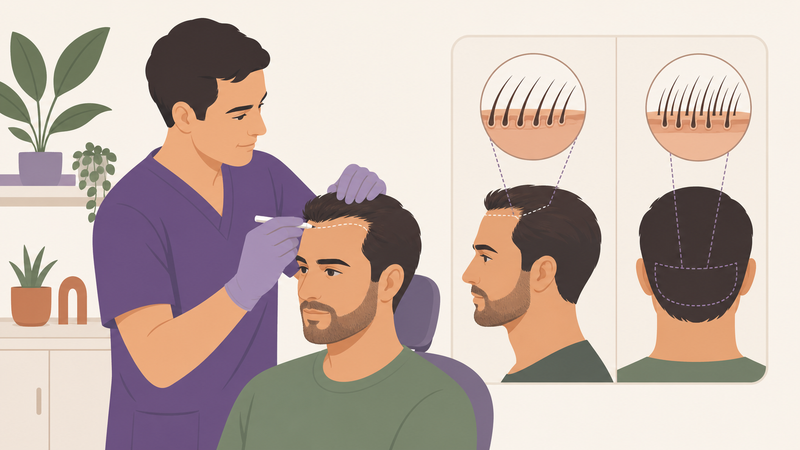
Hairline design matters because an overly low, straight or uniformly dense hairline reads as artificial even when every graft grows. A natural frontal hairline is not a line. The hair restoration literature describes it as a set of zones: a soft, irregular transition zone at the leading edge, a denser defined zone behind it, a frontotemporal angle where the front turns towards the temple, and temporal points that frame the face (4).
Three design decisions carry most of the visual weight:
- Height. A hairline placed at the position of a nineteen-year-old on a forty-year-old scalp commits donor hair to an area that will be surrounded by loss later. Age-appropriate placement generally ages better.
- Irregularity. Real hairlines have small variations in height and contour. Deliberate micro-irregularity at the leading edge is what stops the eye reading a border.
- Graft sequencing. Single-hair follicular units at the very front, with two, three and four-hair units placed progressively further back, create a gradient rather than a wall (4).
Doctor's perspective
Dr Gamze Aksakal explains that natural-looking outcomes depend on careful planning, technique and a person's existing hair characteristics, and that hairline design, graft angles and planned density each play a significant part. She also notes that results and timelines vary between individuals.
- Dr Gamze Aksakal, Hair Transplant Doctor, Gro Clinics Brisbane. AHPRA registration: MED0002059035.
Angle and direction: the detail people notice without knowing why
Hair does not grow at a uniform angle across the scalp. It sweeps forward at the frontal hairline, lies almost flat at the temples, and spirals at the crown. Transplanted grafts have to reproduce that variation, because a graft set at the wrong angle catches the light differently from the hair around it. This is the difference the eye registers as "something has been done" long before it can identify what.
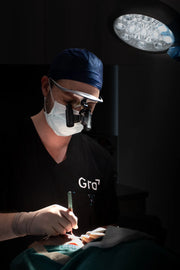
Angle and direction are controlled at the moment the recipient site is created. That is the real function of any placement device, including the one used at Gro: control over the angle, depth and direction of each graft as it goes in. It is a placement control, not an extraction control, and no device removes the need for the person holding it to have decided where each graft belongs.
Density planning: distribution beats quantity
Density planning is the decision about where a limited number of grafts go, not how many are used. This is where the most common misunderstanding in cosmetic hair restoration sits: people compare graft numbers as though a larger number is a better result.
Doctor's perspective
Dr Anwar Al-Abedi points out that discussing graft numbers without context can create a misunderstanding about density and expected coverage. Grafts are how hair is moved, but each graft carries a different number of hairs, so the hair count is what influences coverage. He describes the planning task as considering how many hairs are being redistributed, where they are placed, and how that will look over time, rather than focusing on a single graft number.
- Dr Anwar Al-Abedi, Medical Practitioner, Gro Clinics Sydney. AHPRA registration: MED0002571399.
Two other variables change how much coverage a given number of grafts appears to deliver, and neither is under anyone's control:
- Hair calibre. Thicker hair shafts block more light and create the appearance of greater bulk. Finer hair needs more of it to look equally full (5).
- Curl and wave. Densely curled hair can create an appearance of fullness with fewer grafts than straight, fine hair (5).
Scalp-to-hair colour contrast works the same way. Dark, straight, fine hair on a pale scalp is the least forgiving combination, and the donor-harvesting literature specifically flags low shaft diameter, high contrast, straight hair and short hairstyles as the conditions under which thinning becomes visible soonest (6).
A hypothetical planning example
This example is illustrative only and does not describe or predict any individual outcome.
Two people present with the same pattern of frontal recession and are quoted a similar graft number. Person A has coarse, slightly wavy mid-brown hair and an olive scalp. Person B has fine, straight dark hair and a fair scalp, and a family history suggesting the loss will keep progressing. The same graft count will not produce the same perceived coverage. Person A's hair characteristics do more of the work. Person B's plan may need a more conservative hairline, a tighter treatment area, more donor hair held back for later, and a discussion about medical treatment for the hair that is still there. Neither plan is better. They are answers to different questions.
The donor area sets the ceiling
The donor area is a finite resource that does not regenerate. Every graft taken is permanently gone from the back and sides. This is the constraint that governs every other decision, and it is why "how many grafts can I get?" is the wrong question. The right one is: how many can be taken without the donor area itself starting to look thin?
The published guidance is specific. Most FUE practitioners regard 10 to 15 excisions per square centimetre as a safe single-pass density in someone with a baseline donor density of roughly 65 to 75 follicular units per square centimetre. A first pass at that rate leaves a residual density around 55 to 60; a second pass reduces it to 40 to 45; a third to 25 to 30, at which point visible thinning should be expected (6). A study of 103 men found that donor areas rated good in appearance after FUE had both higher hair density and thicker hair shafts, and concluded donor density should not fall below about 105 hairs per square centimetre to maintain a good appearance (7).
Doctor's perspective
Dr Hisham Khalid describes the donor area as the starting point of every hair restoration procedure and as a finite resource, which is why he considers careful planning essential. He explains that assessing donor density and quality is what determines how many grafts are available, how much density can realistically be built, and how low a hairline it is possible to design, and that this assessment feeds both short-term and long-term planning.
- Dr Hisham Khalid, Hair Transplant Doctor, Gro Clinics Brisbane. AHPRA registration: MED0002551412.
Recovery: what actually happens, and when
Recovery timing varies between individuals, but the sequence is consistent. Healing begins immediately. Redness, swelling and crusting are expected in the first days to weeks. Transplanted hair shafts then shed, typically within the first few weeks, while the follicles remain in the scalp. A quiet period follows, then new growth begins after several months and continues to change over roughly twelve to eighteen months.
The shedding phase is the part people are least prepared for, and the part most often misdescribed online.
What the evidence says about post-procedure shedding
A figure of "30 to 80% of patients experience shock loss" circulates widely across hair transplant content without a consistent source or definition. The peer-reviewed picture is different, and the difference is definitional: shedding of the transplanted hair shafts is an expected part of the follicle cycle in essentially everyone, whereas effluvium, the temporary shedding of surrounding native hair recorded as a complication, is reported far less often. The two are frequently reported as one number.
| Source (year) | Study type and size | What it reports | Flag |
|---|---|---|---|
| Liu et al., Aesthetic Plastic Surgery (2025) (8) | Scoping review, 43 publications | Overall complication rates of 1.2% and 4.7% in two large series; effluvium up to 4.1% at the donor site and 6.5% at the recipient site | Scoping review of heterogeneous studies; captures recorded complications, not expected shedding |
| Single-centre retrospective, Aesthetic Plastic Surgery (2023) (9) | Retrospective, 621 patients (554 men, 67 women) | 23 patients recorded recipient-site shock loss; sex was a significant risk factor, with women at markedly higher risk, and age a further risk factor among women | Single centre, one population, heavily male sample; the female subgroup is small |
| Review of FUE complications, PMC (2026) (10) | Narrative review, PubMed and Embase to Sept 2025 | Overall complication rates between 1.2% and 4.7%; most events mild and self-limited, including temporary effluvium | Narrative rather than systematic; incidence figures inherit the limits of the source series |
The practical reading: expect the transplanted hairs to shed. Native hair around the treated area may also shed temporarily, more commonly in women, and it usually returns. A number quoted without saying which of those two it refers to is not telling you much.
Aftercare that has consensus behind it
An international expert consensus on pre- and post-transplant care, developed by 36 practitioners across 18 countries, recommends oral analgesia with NSAIDs and paracetamol and cold compresses for frontal swelling, a progressive return to normal washing, brushing, colouring and styling, and avoiding sun exposure in the first month. It also recommends that people with androgenetic alopecia be prescribed appropriate medical therapy to protect the hair that was not transplanted, and that in people under 30, medical therapy be established at least six months before a procedure to confirm the loss has stabilised (11).
That last point is the one worth sitting with. A transplant does not treat the underlying condition. Without treatment for the hair that remains, a natural-looking result can become an island of transplanted hair surrounded by continuing loss.
Limitations, risks and the things a transplant cannot do
A transplant redistributes hair. It does not create new follicles, and it does not stop pattern hair loss. Hair in the non-transplanted areas can keep thinning, which is why long-term planning matters more than the appearance of the result at twelve months.
Reported complications of modern hair transplant procedures include bleeding requiring intervention, persistent numbness, infection, folliculitis, persistent redness at the recipient site, donor-site scarring and depletion, temporary effluvium at either site, and unnatural-looking results. Two large series put overall complication rates at 1.2% and 4.7% (8). Documented risk factors include diabetes, hypertension, smoking, a tendency to abnormal scarring, and technical factors such as inadequate planning, poor graft handling, overharvesting and excessive placement density (10).
Not everyone with hair loss is a candidate. A review of surgical candidacy in pattern hair loss identifies eight groups who are generally not appropriate candidates: people with diffuse unpatterned alopecia, cicatricial (scarring) alopecia, unstable hair loss, insufficient hair loss, very young people, people with unrealistic expectations, people with conditions such as body dysmorphic disorder or trichotillomania, and people who are medically unfit (12). Suitability can only be determined by a practitioner assessing the individual.
Women and diffuse thinning: a different assessment
Women's hair loss more often presents as diffuse thinning across the top of the scalp and a widening part line, with the frontal hairline retained. That changes the assessment in three concrete ways.
The donor area has to be checked first, not assumed. The distinction that decides candidacy is between diffuse patterned alopecia, where thinning follows a pattern confined to the top of the scalp and the back and sides remain stable, and diffuse unpatterned alopecia, where miniaturisation extends into the donor area as well. Grafts taken from a donor area that is itself thinning carry the same vulnerability with them. People with diffuse unpatterned alopecia are not candidates, and medical treatment rather than a procedure is the appropriate route (12).
The cause needs investigating before the plan. Thyroid conditions, iron status, PCOS, post-partum changes, medications and scarring alopecias all present as thinning and are managed differently. Trichoscopy is recommended before a transplant is considered, to exclude subtle scarring alopecias and non-focal alopecia areata (11).
The shedding risk profile differs. In the 621-patient series above, being female was a significant risk factor for recipient-site shock loss, and among women, older age increased that risk further (9). Worth knowing before, not after.
Design differs too. Where a man's plan often rebuilds a receded frontal hairline, a woman's plan more often adds density behind an existing hairline and along a widened part, working between native hairs rather than into bare scalp. Hair texture, curl pattern, calibre and styling preferences all feed into how many grafts are needed and where they go.
How Gro approaches natural results
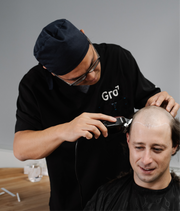
Gro uses FUE harvesting with a precision placement device that creates the recipient site and sets the follicle in one motion, giving the treating doctor direct control of the angle, depth and direction of each graft during placement, rather than the two-step approach of making all the sites first and placing grafts afterwards. Gro's internal name for this approach is Precise Follicle Placement (PFP). It is Gro's method within the broader FUE category, not a separate universally recognised procedure type, and it may not lead to different clinical outcomes.
Two structural points matter more than the instrument:
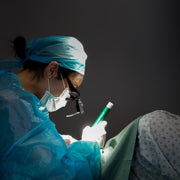
The advisor and the doctor are two different people. A Hair Growth Advisor listens to your situation, discusses your goals and maps your options. The advisor advises; the advisor does not perform a clinical assessment or decide medical suitability. Your treating doctor personally reviews your case, confirms the plan with you before anything begins, and performs the procedure. The full procedure is performed by the treating doctor and is never delegated to a technician.
Follow-up is part of the plan, not an add-on. Follow-up care is provided free for up to 18 months, with a dedicated out-of-hours contact. That timeframe is not arbitrary: it matches how long transplanted hair takes to finish maturing. Where clinically appropriate, the doctor may discuss Prescription Haircare to protect hair that is still active, or preparation and regenerative options such as Growth Factor Therapy (PRP), PRF, low-level light therapy, scalp microneedling or exosome therapy, which are intended to help prepare and support donor follicles ahead of time. Grafts may be held in Hypothermosol during the procedure, a medical-grade solution originally developed for organ transplant procedures, intended to help keep grafts viable between extraction and placement.
If a transplant is not right for you yet, or your donor area will not give a result both you and the doctor would be pleased with, you will be told that before price is discussed. The same procedure, inclusions and standard apply at Sydney, Melbourne, Perth, Gold Coast, Brisbane and Auckland. You can read more about the method on the our method page, or see documented outcomes on the before and after page.
Questions worth asking any Australian clinic
Ahpra's advertising guidelines for higher risk non-surgical cosmetic procedures require that claims about practitioner experience and qualifications be accurate and verifiable, that registration details including registration numbers be provided, and that risks, recovery time and potential side effects be included (3). That gives you a reasonable checklist:
- Who performs each part of the procedure, the harvesting and the placement, by name and registration number?
- How was my donor density measured, and what residual density will I be left with?
- What allowance does this plan make for hair loss over the next ten to fifteen years?
- Will grafts be held back for a possible second procedure, and how many?
- What is the recommended treatment for the hair I still have?
- What is included in the quoted price, and what is not?
- What follow-up is provided, for how long, and with whom?
- What would make you tell me not to proceed?
Frequently asked questions
What makes a hair transplant look unnatural?
Most unnatural results trace back to design rather than growth. A hairline placed too low or too straight, an abnormal frontotemporal angle, grafts set at the wrong angle for their zone, and multi-hair grafts placed at the very leading edge all read as artificial even when the hair grows well. Failing to allow for continuing loss is the other common cause: a dense transplanted patch surrounded by later thinning looks obvious in a way it did not at twelve months.
Is DHI better than FUE?
The comparison does not hold, because they describe different steps. FUE is a way of harvesting follicles; DHI is a way of placing them, and it is used with FUE harvesting. The meaningful questions are who performs the harvesting and placement, how angle and depth are controlled, and how long grafts spend outside the body. Claims that one branded technique produces better outcomes than another should be treated as claims requiring evidence.
How long until a hair transplant looks natural?
Transplanted hair typically sheds within the first weeks, then regrows over several months, with changes continuing across roughly twelve to eighteen months. Timelines vary between individuals, and factors such as general health can influence them. Assessing the result before twelve months usually means assessing an incomplete one.
Will people be able to tell?
In the first week or two, yes. Redness, crusting and swelling in the recipient area are visible during early healing, and the donor area settles at its own pace. Beyond that, how detectable a result is depends on design quality, graft angle, density distribution and individual hair characteristics. No clinic can promise an undetectable result, and any that does is making a claim it cannot support.
Can women have a hair transplant?
Some women can. It depends on whether the donor area is stable. Where thinning follows a pattern confined to the top of the scalp and the back and sides remain unaffected, a transplant may be appropriate. Where miniaturisation extends into the donor area, it is not, because the grafts would carry the same vulnerability with them. Investigating the cause of the loss, including thyroid, iron, hormonal and scarring conditions, comes before any decision about a procedure.
How many grafts will I need?
Graft numbers vary between individuals and depend on the pattern of loss, existing density, donor supply and the agreed design. A figure can only be estimated after an assessment. Graft count is also a weaker guide than it seems, because each graft carries between one and four hairs; two people quoted the same number can receive very different hair counts.
Does a hair transplant last?
Follicles taken from the safe donor area are generally more resistant to pattern hair loss, though resistance is not absolute and is not guaranteed in every case. The larger issue is that the hair around them can continue to thin. International consensus recommends medical therapy for people with androgenetic alopecia specifically to protect the non-transplanted hair (11).
Is a hair transplant regulated in Australia?
Yes. Ahpra classifies hair transplants as a higher risk non-surgical cosmetic procedure. Guidelines in effect from 2 September 2025 set requirements for practitioners performing and advertising these procedures, including accurate and verifiable claims about experience, disclosure of practitioner registration details, and inclusion of risks, recovery time and potential side effects in advertising (3).
What happens to the donor area?
FUE leaves small circular scars roughly 1 mm across, which are usually not visible at typical hair lengths but can become apparent if the donor area is overharvested or the hair is worn very short. Donor density falls with each procedure and does not recover. Published guidance treats a residual density in the 40 to 50 follicular units per square centimetre range as the point where visible thinning becomes a real risk, sooner if the hair is fine, straight, dark against a pale scalp, or worn short (6).
Should I try medication before considering a procedure?
Often, yes, and in younger people it may be recommended as a first step. Expert consensus advises that people under 30 with androgenetic alopecia establish appropriate medical therapy at least six months before a transplant, to confirm the loss has stabilised (11). A practitioner needs to assess you and prescribe; this is not something to self-direct.
Where to start
If you want to understand your options before committing to anything, a free 15-minute Discovery Call is a straightforward way to ask general questions and understand the next steps. It is not a medical consultation or suitability assessment. Where appropriate, the team can help arrange an in-clinic consultation with a personalised treatment plan.
Important information
PFP is Gro's internal method within the broader FUE category and may not lead to different clinical outcomes. Individual results and recovery vary. Prescription haircare and regenerative treatments are available following a consultation with a doctor to assess suitability. Individual results may vary. An individual assessment is required to determine suitability. Results referenced from clinical studies are population-level findings and do not necessarily reflect outcomes any other individual may experience. This article is general information only and is not medical advice. It does not replace an individual assessment by a qualified practitioner.
References
- 1. Follicular Unit Excision (FUE) resources and terminology, International Society of Hair Restoration Surgery, 2019
- 2. Direct hair transplantation: a modified follicular unit extraction technique, Journal of Cutaneous and Aesthetic Surgery, 2013
- 3. Advertising higher risk non-surgical cosmetic procedures, Australian Health Practitioner Regulation Agency, 2025
- 4. Hairline design and frontal hairline restoration, Facial Plastic Surgery Clinics of North America, 2013
- 5. Hair characteristics: a major consideration in hair transplantation, International Society of Hair Restoration Surgery, n.d.
- 6. Donor harvesting: follicular unit excision, Journal of Cutaneous and Aesthetic Surgery, 2018
- 7. Donor site of follicular unit excision hair transplantation: the relationship between appearance and actual hair density, and hair diameter, Journal of Plastic Surgery and Hand Surgery, 2020
- 8. A scoping review on complications in modern hair transplantation: more than just splitting hairs, Aesthetic Plastic Surgery, 2025
- 9. An analysis of risk factors of recipient site temporary effluvium after follicular unit excision: a single-centre retrospective study, Aesthetic Plastic Surgery, 2023
- 10. Complications in follicular unit excision hair transplantation: current evidence and practical approaches, Frontiers in Medicine, 2026
- 11. An international expert consensus statement focusing on pre and post hair transplantation care, Journal of Dermatological Treatment, 2023
- 12. Is every patient of hair loss a candidate for hair transplant? Deciding surgical candidacy in pattern hair loss, Indian Journal of Plastic Surgery, 2021