



Key Takeaways
Many misconceptions about low-level laser/light therapy (LLLT) persist because clinical trials vary in device type, dose, and treatment protocols, and the consumer market includes products of uneven quality. One common misconception is that LLLT works for all types of hair loss, whereas the strongest evidence is for androgenetic alopecia, where studies show modest improvements in hair density and thickness.
With androgenetic alopecia potentially affecting 85% of men and 40% of women over their lifetimes (1), laser therapy may support hair regrowth for many different people.
We've collated all the evidence on clinical trial results, safety, side effects, and costs in Australia.
What Is Low-Level Laser Therapy (LLLT) for Hair Loss?
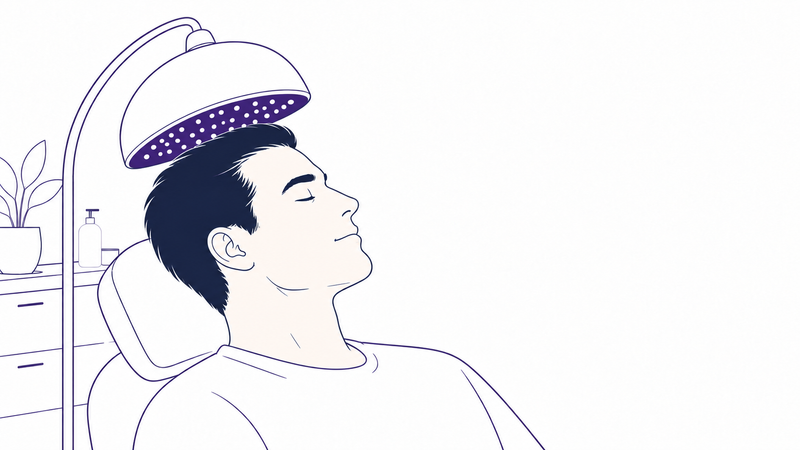
Low-level laser therapy is a non-invasive treatment for hair loss that uses red light wavelengths to support hair follicles and promote blood flow. The light is believed to assist in maintaining follicle function by promoting a healthy scalp environment.
There are many different products and names under the LLLT umbrella, including:
- Photobiomodulation = the umbrella concept and scientific field.
- Red light therapy = a popular consumer term, often used for LED-based devices that emit red light.
- Cold laser = an older marketing term for low-level laser/light therapy, usually meaning non-thermal light treatment.
- Laser caps = a delivery device for scalp treatment, not a separate treatment mechanism; they may use laser diodes, LEDs, or a mix depending on the product.
While individual responses vary, many people choose LLLT as part of a broader, consistent approach to hair maintenance. It is typically recommended for those in the early stages of male or female pattern hair loss.
How Does Low-Level Laser Therapy Work?
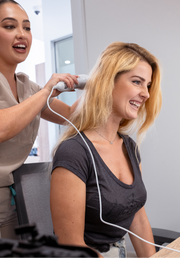
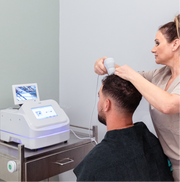
LLLT is non-invasive, and most people find it comfortable, though individual experiences vary:
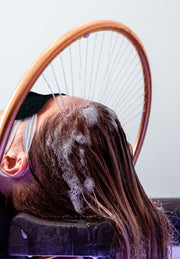
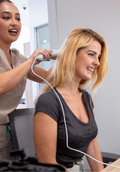
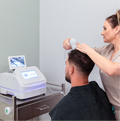
- The device is placed on the scalp, usually as a cap, helmet, or comb. Gro Clinics uses a clinical-grade device, and LLLT is performed by experienced registered practitioners with safety measures in place.
- The light is absorbed by the scalp and is believed to help promote blood flow in the treated area.
- The follicles may become more active and shift toward the anagen, or growth, phase.
- Over time, some hairs may become thicker and denser, especially in pattern hair loss.
- The process has to be repeated regularly for weeks to months to see results.
Generally, users don't need any recovery time after treatment and may return to normal activities straight after the treatment.
Does Low-Level Laser Therapy Actually Work? What the Evidence Shows
Multiple controlled trials show measurable regrowth for those experiencing androgenetic alopecia. However, each study may use a different dosage, device or control, so we have collated this evidence to showcase the differences in results.
Note that Results referenced from clinical studies are population-level findings and do not necessarily reflect outcomes other patients may experience.
Laser combs (you comb it through your hair)
A handheld comb studded with tiny red lasers that you slowly comb across your scalp a few times a week.
| Study (click to open) | What they used | Who tried it & for how long | What happened |
|---|---|---|---|
| Efficacy and Safety of a Low-level Laser Device in the Treatment of Male and Female Pattern Hair Loss, Jimenez, 2014 | HairMax LaserComb, a handheld comb with 7–12 tiny red lasers (655 nm red light). | 269 men & women · combed 3× a week (8–15 min) for about 6 months. | Grew about 15 more hairs per cm² than a look-alike dummy comb. No serious side effects. |
Helmets & caps (you wear it, hands-free)
A cap or helmet lined with lasers and/or LED bulbs. You wear it for a set time, and it does the work for you. This is the most studied form of laser therapy.
| Study (click to open) | What they used | Who tried it & for how long | What happened |
|---|---|---|---|
| Lanzafame (men), 2013 | TOPHAT655 helmet with 21 lasers \+ 30 red LED bulbs, worn like a cap (655 nm). | 44 men · worn every second day for 4 months. | 35% more hair than the men who wore a fake helmet. |
| Lanzafame (women), 2014 | TOPHAT655 helmet with 21 lasers \+ 30 red LED bulbs, worn like a cap (655 nm). | 47 women · worn every second day for 4 months. | A clear increase in hair, at a similar rate to the men’s result. |
| Yoon, 2020 | A red-light helmet combining lasers and LEDs (655 nm). | 60 people · worn once every 2 days for 4 months. | Gained about 42 more hairs per cm² versus almost none (under 1\) in the fake-helmet group. Hair also got slightly thicker. |
| Suchonwanit, 2019 | A home-use laser helmet (RAMACAP, 655 nm red light). | 40 people · 20 minutes, 3× a week for 6 months. | Noticeably more hair and thicker strands than the dummy device. The only side effects were some temporary shedding and an itchy scalp. |
| Kim, 2020 | A newer helmet mixing three red-light sources (630 / 655 / 660 nm). | Worn for 4 months, compared against a fake helmet. | More hair than the dummy device. |
| Shin, 2026 | A red-light helmet with 250 lasers/LEDs (LG’s Pra.L, 646–675 nm). | 68 people · 20 minutes, 3× a week for a full year. | Gained about 25 more hairs per cm² over 12 months, and results kept improving after the 6-month mark. |
Studies of multiple clinical trials
These don’t test a device themselves; they pool the results of many trials together. Because they draw on hundreds of people, they’re the most reliable guide to whether the treatment truly works.
| Study (click to open) | What they used | Who tried it & for how long | What happened |
|---|---|---|---|
| Gupta & Carviel, 2019 | Combined 15 separate trials (both laser and LED devices, 630 - 660 nm). | 795 people altogether. | Found a clear, sizeable overall benefit for red-light therapy, and lasers worked a bit better than LED-only devices. |
| Liu, 2019 | Combined 11 randomised trials (630 - 808 nm). | 667 people altogether. | Reported a real benefit and, surprisingly, using the device less often (under an hour a week total) worked better than heavy daily use. |
| Lueangarun, 2021–22 | Combined 7 trials of FDA-cleared home devices (combs and helmets, 650 - 678 nm). | Both men and women, across device types. | Reported a clear benefit across devices, for both sexes. |
Every study cited works by pitting a working LLLT device against an identical dummy device, ranging from LED combs to wearable helmets and treatments. All trials showed notable hair growth from LLLT treatment, ranging from 15 to 42 extra hairs per square centimetre of scalp over 4 to 12 months.
The most reliable studies combined 7 to 15 trials and hundreds of people to get a more thorough overview of results. All three studies quoted reported a positive hair growth result for both men and women, with some suggesting that laser devices edge out LED-only ones, and that 655 nm red light is the best-tested wavelength.
Despite the studies varying in device, dosage and results, they all indicate that low-level light therapy may support hair growth. It is an approach supported by clinical research for hair regrowth or hair thickness for many people, but it's best understood as steady maintenance plus modest regrowth, not a cure.
Always note that people experience hair loss and regrowth differently; results may vary.
Does Low-Level Laser Therapy Have Side Effects?
LLLT is generally considered low-risk, but it is not completely side-effect-free. The most commonly reported issues are mild and temporary (12):
- Mild scalp irritation or itchiness.
- Dryness or temporary changes in hair texture.
- Headache in a small number of users.
In the 2014 study on lasercomb treatment for hair loss, no serious adverse events were reported in any subject in any of the four trials (2). The 2019 study on helmet/cap LLLT treatment stated: "In conclusion, the novel helmet-type LLLT device appears to be an effective treatment option for AGA in both male and female patients with minimal adverse effects." (6).
Gro Clinics LLLT is performed by experienced registered practitioners with safety measures in place. A consultation is required to assess suitability and discuss any possible side effects.
LLLT vs Minoxidil, Finasteride and PRP
LLLT treatment works differently from prescription medication or platelet-rich plasma (PRP), but may be paired with them as part of a personalised treatment plan for hair loss.
| Treatment | What it is | Typical Use | Supported Evidence |
|---|---|---|---|
| LLLT | Non-invasive treatment using red light wavelengths to support hair follicles and promote blood flow. | Used as a home device or clinic treatment. | A 2026 study showed patients gained about 25 more hairs per cm² over 12 months, and results kept improving after the 6-month mark (8). |
| Minoxidil | Active ingredient used in prescription hair medication, including topical solutions, to help promote blood flow to support the growth cycle. | Usually applied daily as a 2% or 5% topical solution or foam, and it is a standard first-line option. | A 2025 PRISMA-compliant review of seven clinical trials found that using topical minoxidil and finasteride together was associated with greater mean improvements in hair density and hair thickness compared with minoxidil alone (14). |
| Finasteride | Active ingredient used in prescription hair medication, including topical solutions, to reduce DHT, the scalp hormone that causes follicle shrinkage. | Commonly taken as 1 mg daily in men. May be combined with minoxidil in a topical solution. | A 2025 PRISMA-compliant review of seven clinical trials found that using topical minoxidil and finasteride together was associated with greater mean improvements in hair density and hair thickness compared with minoxidil alone (14). |
| PRP | Regenerative treatment that uses your body’s own blood concentrate. | Usually done as a series of scalp injections, often monthly or every few weeks. | A controlled trial showed a significant increase in the mean hair count for the treatment area after 3 months (3 months vs. 0 months), with a mean increase of 33.6 hairs in the target area compared with baseline (15). |
As each treatment may support hair regrowth and a healthy hair growth cycle in different ways. In a 2021 clinical study, they found that LLLT produced regrowth comparable to minoxidil; combining the two was more effective (13).
Combination therapy for hair loss may not suit everyone, and a thorough assessment of hair and scalp health is needed to assess suitability. An AHPRA-registered clinic can assess suitability and create a personalised treatment plan with safety protocols and post-care guidance.
At-Home Laser Caps vs In-Clinic LLLT
Both at-home laser helmets or caps and in-clinic LLLT treatments may support hair growth. However, clinic-grade devices are used for in-clinic treatment, performed by experienced registered practitioners with safety measures in place.
At-home LLLT devices are typically less powerful than in-clinic devices, and need to be used more consistently as part of a weekly routine. At-home devices may also vary in quality, and some masks and combs on the market use LED instead of red light-emitting diodes, which may provide much deeper scalp penetration. Some consumer products are marketed for general wellness rather than as therapeutic devices, so it is worth checking the regulatory status and evidence for the specific product. In Australia, it is better to verify whether the actual device is listed on the Australian Register of Therapeutic Goods (ARTG) rather than assuming the clinic treatment itself is TGA-approved.
In-clinic treatment is usually delivered with professional oversight, which may improve safety screening and allow combination with other treatments such as minoxidil, finasteride, or PRP.
LLLT vs Fotona HAIRestart Laser: What's the Difference?
LLLT is a broader category of laser treatment, using low-level red light therapy to support hair follicles. Devices may be combs, helmets or caps for at-home treatment, or clinic-grade devices administered by registered health practitioners.
Fotona HAIRestart is a branded in-clinic treatment that uses a Fotona laser with a specific pulse laser approach. It is a separate laser-based treatment and is not conventional LLLT, but it's a practitioner-led procedure administered by registered health practitioners.
GRO Clinics offers in-clinic LLLT treatment at all clinics, including Sydney, Brisbane, Melbourne, Gold Coast, Perth and Auckland. We also offer Fotona HAIRestart at our Gold Coast location only. A consultation is required to assess suitability.
How Many Sessions and How Long Until Results?
LLLT treatment for hair loss is ongoing and supports modest regrowth. It's not a one-and-done procedure and individual results do vary.
Most people use LLLT at-home devices several times a week as part of a consistent haircare routine. For in-clinic devices, the number of sessions is decided after a scalp analysis and hair history check.
Some people experience hair growth results within 3 - 12 months. A 2026 study showed patients gained about 25 more hairs per cm² over 12 months, and results kept improving after the 6-month mark (8).
Who Is a Good Candidate for LLLT?
LLLT tends to suit males and females with early to moderate androgenetic alopecia. Active hair follicles are usually still present in the early stages of hair loss or thinning.
Laser therapy may not suit those with advanced stages of hair loss and scarring alopecias, as the laser may not be able to stimulate hair follicles.
It is a non-invasive option that many men and women prefer as part of an ongoing hair treatment plan. LLLT may also be used in combination with other treatments and may be used post-hair transplant to support hair follicle cells and potentially promote hair growth.
Why Choose Gro Clinics for LLLT
LLLT treatment may not suit every hair loss experience. Whilst home devices are widely available in Australia and New Zealand, they may vary significantly in quality, and many are not entered in the Australian Register of Therapeutic Goods
Many people choose Gro Clinics for a clinic-grade LLLT treatment, performed by experienced registered practitioners with safety measures in place. The Gro Clinics service includes:
- A free 15-minute discovery call with a hair growth advisor.
- An in-person scalp evaluation.
- AHPRA-registered practitioners.
- In-person care at local clinics.
- Structured, in-clinic training and hands-on education before performing or assisting in procedures for all medical and clinical teams.
- Tailored treatment plans with LLLT often recommended in combination with other treatments, such as prescription medication.
- Flexible payment options for eligible patients.
- Post-treatment support and annual check-ins.
Frequently Asked Questions
Is low-level laser therapy effective for hair loss?
Controlled trials show modest yet measurable hair regrowth for many users. A 2020 study of 60 people showed patients gained about 42 more hairs per cm² and hair also got slightly thicker (5).
Individual experiences and results may vary.
Does laser therapy work for both male and female pattern baldness?
Studies suggest that LLLT may work for both male and female pattern hair loss (3, 4). It may be most effective for those experiencing early to moderate thinning or hair loss where the hair follicles are still active.
Are there any side effects of low-level laser therapy?
Studies show that side effects are mild and uncommon. Some side effects have included mild scalp irritation or itchiness, dryness or temporary shedding.
Although there have been no serious adverse events recorded in any of the studies we mention in this article, note that individual experiences may vary.
Can LLLT regrow hair or only maintain it?
LLLT may promote modest hair regrowth and may help to slow further hair loss. The low-level light therapy may support blood flow in hair follicles and may push cells into the anagen growth cycle.
This treatment may not suit those with underlying hair loss conditions.
Does low-level laser therapy work after a hair transplant?
Low-level laser therapy may typically be used post-hair transplant to support follicle health and healing. Hair follicles need time to heal after incisions, and LLLT may support blood circulation during this time.
Gro Clinics provides personalised treatment plans, which may include both a hair transplant and ongoing LLLT treatment or prescription medication.